

The Psychology Behind Addictive Casual Game Mechanics
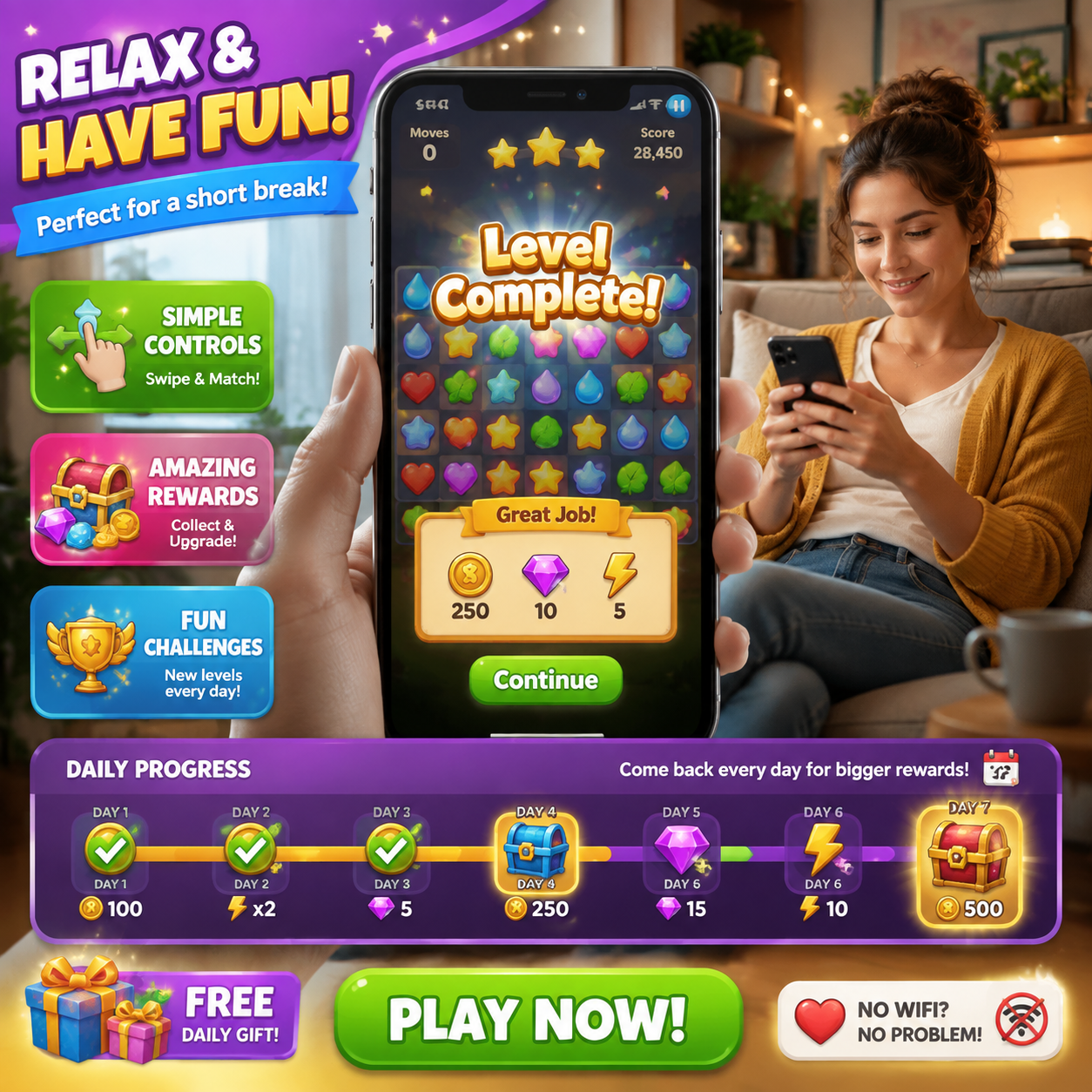
Casual games are easy to open, understand, and play in short bursts. A match, puzzle, runner, farming task, or daily challenge may take only a few minutes, yet the experience can remain remarkably compelling. That pull comes from the way several psychological principles work together: clear goals, rapid feedback, rewarding uncertainty, visible progress, social comparison, and carefully balanced challenge.
The word addictive is common in everyday discussion, but it should not be treated as a clinical diagnosis here. Players respond differently depending on their preferences, mood, habits, and circumstances. The more useful question is this: which mechanics make returning feel rewarding, and when does healthy engagement become excessive pressure?
Why Casual Games Are So Easy to Start
Casual games are easy to start because they reduce friction through simple controls, short sessions, and immediate understanding. Players can often learn the central action within seconds, without reading a manual or mastering a complex control scheme.
A tap, swipe, drag, or matching action creates a low barrier to entry. The first interaction usually produces a visible result, so players quickly understand the relationship between action and outcome. This combination gives the game an accessible opening: the player knows what to do and sees why the action matters.
Short sessions also fit naturally into waiting rooms, commutes, breaks, or quiet moments at home. A game that can be paused or completed in three to ten minutes feels easier to approach than an experience requiring a long uninterrupted commitment. The player can make progress without reorganizing the entire day.
Familiar patterns help as well. Many casual games use recognizable goals such as clearing a board, reaching a target score, decorating a space, or completing a collection. Familiarity lowers mental effort, while small variations preserve curiosity. The result is an inviting first step rather than a demanding learning period.
The Core Gameplay Loop and Repeated Engagement
A casual game loop repeats a simple sequence: the player acts, receives feedback and rewards, makes progress, and encounters a renewed goal. This structure turns individual actions into a reason to continue.
Consider a puzzle game. The player selects pieces, completes a combination, receives points and visual effects, unlocks a small benefit, and sees the next objective. Each stage leads naturally into another. The loop can be described as:
- Action: the player taps, swipes, matches, or chooses.
- Response: the game immediately shows what happened.
- Reward: points, coins, stars, items, or a positive animation reinforce the result.
- Progress: the player moves toward a level, milestone, or collection.
- Renewed goal: a new challenge gives the next action meaning.
Strong game loops keep the next step obvious. They also provide rewards at several time scales. A move may earn instant points, a completed level may unlock a feature, and a week of play may complete a larger collection. These overlapping cycles create both immediate satisfaction and longer-term direction.
The loop becomes less effective when the action lacks meaning or the reward arrives too late. If a player cannot tell whether a move helped, motivation weakens. If every outcome feels identical, the loop may become routine rather than engaging.
Rewards, Anticipation, and Variable Reinforcement
Rewards influence repeated play by combining satisfaction with anticipation, especially when some outcomes vary instead of arriving in a completely predictable pattern. This process is often called variable reinforcement: the player knows an action may produce a reward, but not always exactly which reward or how valuable it will be.
Predictable rewards provide clarity. Completing a level might always grant experience, while finishing a task might always add currency. Unexpected rewards add curiosity: a bonus item, rare decoration, special animation, or extra turn may appear occasionally. The uncertainty encourages attention because the next result could be different from the last.
Dopamine is often discussed in relation to game rewards, but simple explanations can mislead. It is more accurate to say that reward expectation and anticipation can influence motivation and learning. The brain responds to changing expectations, while the player learns which actions tend to produce satisfying outcomes. This does not mean every reward creates the same biological response or that every player will keep playing.
Good design gives variable rewards boundaries. A player should understand the possible outcomes and retain meaningful control. If rewards feel arbitrary, concealed, or essential for progress, anticipation can turn into anxiety. Choosing unpredictable bonuses for excitement means accepting less certainty; the mechanic should not make basic progress depend on luck.
For players evaluating a game, ask whether rewards support the activity or merely interrupt it with repeated prompts. A satisfying reward strengthens the game loop. A reward that exists mainly to delay progress can make the experience feel transactional.
Progression, Goals, and the Psychology of Completion
Progression systems motivate players by making effort visible and by turning small achievements into a larger sense of completion. Levels, streaks, collectibles, milestones, and percentage bars all answer a basic question: how far have I come, and what remains?
Visible progress reduces the feeling that individual actions disappear. A player who completes one level may see a map open, a character improve, or a collection fill another space. Even a small movement on a progress bar can give the next session a clear purpose.
Streaks and daily bonuses work through continuity. Returning tomorrow protects an existing streak or claims a scheduled reward, while a missed day may reset the sequence. This creates a commitment device, but it can also create pressure. A streak feels motivating when it is optional and forgiving; it becomes manipulative when missing one day produces disproportionate loss.
Completion psychology also explains the appeal of near-finished collections. An almost-complete set makes the missing item noticeable, encouraging the player to continue. Designers can use this effect constructively by offering attainable milestones rather than endless unfinished lists.
Loss aversion, the tendency to experience a loss as more painful than an equivalent gain feels pleasurable, often appears in streaks, limited-time tasks, and expiring energy. It can increase attention, yet it deserves careful handling. If the player continues only to avoid losing previous effort, engagement has shifted from enjoyment toward defensive behavior.
Feedback, Challenge, and the Flow State
Instant feedback and a balanced difficulty curve help players stay focused by making actions understandable while keeping challenges achievable. When difficulty matches skill, players may enter a flow state: a period of concentrated involvement in which the task feels demanding but manageable.
Feedback can be visual, auditory, tactile, or textual. A cleared row might change color, produce a sound, and add points immediately. These signals confirm that the game recognized the player’s action. They also teach the rules without requiring long explanations.
The difficulty curve determines how pressure develops. Early levels should establish confidence, while later stages introduce new constraints, combinations, or time limits. If the challenge rises too slowly, boredom follows. If it jumps suddenly, the player may feel that success depends on luck or payment rather than skill.
A useful design test is to separate three states:
- Under-challenged: success feels automatic and attention drifts.
- Well-matched: mistakes are understandable, recovery is possible, and success feels earned.
- Over-challenged: failure feels repetitive, unclear, or unfair.
Flow is not guaranteed by difficulty alone. Players also need clear goals, control over decisions, and enough uninterrupted time to focus. Optional hints can help, but excessive prompts weaken player autonomy by solving decisions before the player makes them.
Social Features and Emotional Investment
Social features increase emotional investment by showing how a player relates to other people, whether through cooperation, sharing, competition, or social comparison. A leaderboard can make a score meaningful because it places performance in a wider context.
Social comparison works in different ways. Seeing a friend slightly ahead may create a reachable target, while an unreachable top rank can discourage participation. Cooperative goals often produce a gentler form of motivation: players contribute toward a shared reward, exchange lives, or help complete a group event.
Sharing can also strengthen identity. Displaying a customized character, completed collection, or high score lets the player communicate taste and achievement. The emotional reward may come as much from recognition as from the game itself.
These systems require choice. Notifications that repeatedly announce another player’s progress can draw people back, but they can also interrupt daily life. Healthy social design makes participation visible without implying that a player owes constant attention to friends or a team.
When Engagement Becomes Manipulative
Engagement becomes manipulative when a game uses pressure, confusion, or loss threats to push play or spending beyond the player’s freely chosen goals. Enjoyable replayability leaves room for refusal; exploitative design makes stopping feel costly or difficult.
Warning signs include artificial scarcity, unclear purchase information, rewards that require repeated interruptions, and timers designed mainly to provoke urgency. A limited-time event can add variety when it is clearly explained and returns regularly. The same event becomes coercive when players fear permanently losing content or feel compelled to spend to preserve progress.
Manipulation can also appear in the combination of mechanics. A streak, variable reward, social notification, and energy timer may each seem harmless alone. Together, they can create a strong pressure cycle: return now, avoid losing progress, claim the uncertain reward, and keep pace with others.
For a practical evaluation, use the choice, clarity, cost, and recovery test:
- Choice: Can the player ignore the mechanic without being punished?
- Clarity: Are rules, probabilities, timers, and prices understandable?
- Cost: Does the mechanic demand disproportionate time, money, attention, or emotional energy?
- Recovery: Can players pause, miss a day, or make a mistake without losing excessive progress?
Healthy casual games can encourage breaks, offer notification controls, avoid shame-based messages, and preserve player autonomy. The goal is sustained enjoyment, not maximum compulsion. Players can apply the same framework by checking whether they are returning because they want to play or because the game has made stopping uncomfortable.
Frequently Asked Questions
What makes a casual game addictive?
A casual game may feel addictive when a simple game loop combines immediate feedback, satisfying rewards, visible progression, manageable challenge, and a clear reason to return. Individual motivation and context still determine how strongly these mechanics affect someone.
How do reward systems influence player behavior?
Reward systems teach players which actions produce desirable outcomes. Predictable rewards clarify goals, while variable rewards add anticipation. If rewards become necessary for ordinary progress, they can shift engagement toward pressure.
Why are streaks and daily bonuses effective?
Streaks and daily bonuses make continuity visible and create a near-term reason to return. They also activate loss aversion when a player risks losing accumulated progress, which is why forgiving streak systems are more respectful.
What is the difference between engagement and manipulation?
Engagement supports voluntary enjoyment through clear goals and meaningful choices. Manipulation relies on hidden costs, artificial urgency, confusing information, or fear of loss to make continued play or spending feel compulsory.
How can casual games encourage healthy play?
Games can support healthy play with optional reminders, accessible pause points, transparent purchases, flexible streaks, reasonable session goals, and social features that do not punish absence. These choices protect autonomy while preserving the pleasure of progress.