
Top 10 Casual Games That Defined a Generation: A Look Back at the Titles That Changed Everything
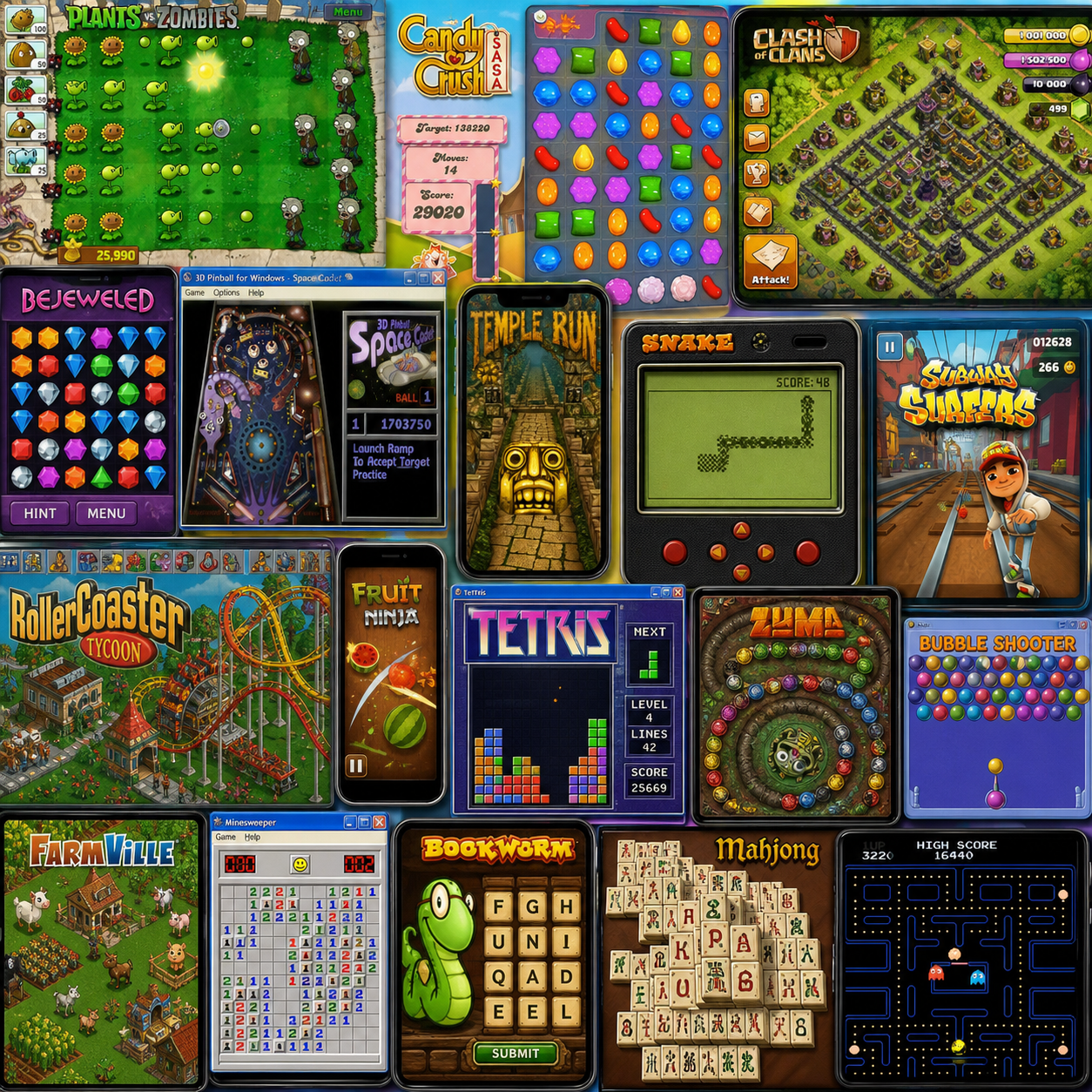
Some games don't just entertain — they rewire how entire populations think about play. The casual games that emerged between the late 1990s and mid-2010s did exactly that. They turned lunch breaks into puzzle sessions, waiting rooms into competitive arenas, and family dinners into debates about high scores. This is a look back at the titles that genuinely changed things.
What Makes a Casual Game "Generation-Defining"?
A generation-defining casual game is one that broke out of the gaming niche and became part of everyday life for millions of people who never considered themselves gamers. The criteria here aren't about revenue charts or awards. They're about cultural reach, accessibility, and whether the game left a mark on how people think about interactive entertainment.
Four factors guided this list:
- Accessibility — Could anyone pick it up in under a minute?
- Cultural penetration — Did it show up in offices, schools, and family conversations?
- Mechanical innovation — Did it introduce or popularize a game mechanic that others copied?
- Lasting footprint — Are its design principles still visible in games released today?
Games that score high on all four aren't just popular — they're foundational. They shaped what casual gaming means as a category.
The Golden Age of Browser and Early Mobile Gaming
The era that produced most of these titles spans roughly 1998 to 2014 — a window that covers Flash-based browser gaming, the rise of social gaming platforms, and the first explosive years of smartphone app stores. Each phase expanded the mainstream audience in ways the traditional games industry hadn't anticipated.
Browser gaming democratized access. No console required, no download necessary — just a computer and a lunch break. Then social platforms like Facebook gave casual games a distribution engine that bypassed retail entirely. Finally, mobile gaming put these experiences in every pocket on the planet.
What connected all three phases was the same underlying shift: gaming stopped being a hobby and became a behavior. People weren't scheduling time to play — they were filling micro-moments throughout the day. That behavioral change is the real legacy of this era.
The Top 10 Casual Games That Left Their Mark

Each entry below earned its place by meeting at least three of the four criteria above. Platform origin and standout mechanic are noted for each — because understanding why a game worked is more useful than simply listing what it was.
1. Tetris (1984, multi-platform)
The grandfather of casual puzzle games. Its falling-block mechanic is so intuitive it's been studied by cognitive scientists. Tetris proved that a game with no story, no characters, and no end state could hold attention indefinitely through pure mechanical satisfaction.
2. Minesweeper (1990, Windows)
Bundled with Windows and played by hundreds of millions of office workers who had never bought a game in their lives. Minesweeper is arguably the first truly mass-market casual game — not because it was designed for mass markets, but because distribution made it unavoidable.
3. Solitaire (1990, Windows)
Originally built to teach mouse usage, Solitaire became the most-played card game in human history. Its single-player, low-stakes loop made it the defining stress-relief game of the pre-smartphone era.
4. Bejeweled (2001, browser/mobile)
PopCap's match-3 puzzle game didn't invent the genre, but it perfected it. The satisfying cascade of gem explosions created a feedback loop that developers are still replicating. Bejeweled is the direct ancestor of Candy Crush and every match-3 title that followed.
5. Diner Dash (2004, browser/PC)
Time-management gameplay for an audience that had never touched a strategy game. Diner Dash brought working adults — particularly women in their 30s and 40s — into casual gaming in numbers the industry hadn't seen before.
6. FarmVille (2009, Facebook)
Zynga's farming sim wasn't technically impressive, but its social mechanics were revolutionary. Needing friends to progress turned a casual game into a social obligation. At its peak, FarmVille had more daily active users than Twitter. It defined the social gaming era and introduced the freemium model to a mass audience.
7. Angry Birds (2009, mobile)
Rovio's physics-based slingshot game became the first mobile casual game to achieve genuine pop culture status — merchandise, animated series, and a film followed. It demonstrated that mobile gaming could carry a brand, not just a mechanic.
8. Cut the Rope (2010, mobile)
Physics puzzles wrapped around a genuinely charming character. Cut the Rope showed that casual games could have personality without sacrificing simplicity, raising the bar for indie developers entering the mobile space.
9. Candy Crush Saga (2012, mobile/Facebook)
King's match-3 juggernaut became the defining example of the freemium engagement loop done at scale. Love it or criticize it, Candy Crush Saga shaped how mobile gaming services approached monetization, session design, and social pressure mechanics for the next decade.
10. Flappy Bird (2013, mobile)
A one-person development project that generated 50 million downloads in under a month. Flappy Bird's brutal difficulty created a shared cultural experience — everyone was failing at the same thing, together. Its viral spread through social media was a preview of how casual games would travel in the years ahead.
The Game Mechanics That Made Them Irresistible
These ten games look very different from each other, but they share a common mechanical DNA. Understanding that DNA explains why casual gaming found such a massive audience.
Short session design is the first pillar. Every game on this list can be played meaningfully in under three minutes. That isn't an accident — it's a deliberate design choice that makes the game fit into life rather than demanding time away from it.
The second pillar is immediate feedback. Gems explode, birds crash, crops grow. The visual and audio response to player actions is fast, clear, and satisfying. This feedback loop triggers the same reward pathways that make any habit-forming activity sticky.
Third: simple controls, escalating challenge. Tap, swipe, click — the input vocabulary is tiny. But the difficulty curve keeps players at the edge of their ability, which is where engagement lives. This balance is harder to achieve than it looks, and the games that got it right became classics.
How These Games Expanded the Definition of "Gamer"
Before casual gaming went mainstream, the cultural image of a "gamer" was narrow and specific. These titles dismantled that image by bringing in audiences the traditional games industry had largely ignored.
Diner Dash found working mothers. FarmVille reached retirees. Angry Birds converted business travelers. Candy Crush became a fixture in waiting rooms across age groups. The common thread wasn't demographics — it was context. These games fit into moments of transition: commuting, waiting, winding down.
That expansion had real consequences. Game developers started designing for different postures (lying in bed, standing on a train), different attention spans, and different motivations. Stress relief, social connection, and simple time-passing became legitimate design goals alongside competition and achievement. The casual gaming audience didn't just grow the market — it changed what the market was for.
The Legacy They Left on Today's Casual Gaming Scene
The influence of these ten games runs directly into the present. Modern casual and mobile gaming didn't emerge independently — it grew from the soil these titles prepared.
Match-3 mechanics from Bejeweled appear in hundreds of current titles. The social obligation loops pioneered by FarmVille evolved into the guild systems and limited-time events that drive engagement in today's mobile games. Flappy Bird's one-tap endless runner format became a template for an entire subgenre. Even the freemium model — now the dominant monetization approach across mobile gaming services — traces its mass-market adoption back to the social gaming era these games defined.
What's changed is polish and scale. Today's casual games have higher production values, more sophisticated engagement loops, and global distribution through app stores and online gaming platforms. What hasn't changed is the core appeal: accessible, rewarding, and built for the way people actually live.
Why Casual Games Still Matter in Interactive Entertainment
Casual games remain the largest segment of the global games market, and their cultural role goes beyond download numbers. They serve as the entry point into interactive entertainment for most people on the planet.
For someone who has never played a console game, a well-designed casual puzzle is their first experience of what games can feel like — the agency, the feedback, the small victories. That first experience shapes whether they go deeper into gaming or stay at the surface. Casual games are, in that sense, the front door of interactive entertainment.
The titles on this list didn't just entertain a generation. They built the habits, expectations, and audience that the entire games industry now depends on. That's worth remembering the next time someone dismisses match-3 puzzles as "not real games."
Frequently Asked Questions
What qualifies a game as a "casual game"?
A casual game is designed for accessibility and short play sessions, with simple controls and rules that can be learned in minutes. The genre prioritizes broad appeal over depth or complexity, targeting players who don't identify as dedicated gamers.
Are casual games considered real video games?
Yes. Casual games are a legitimate category within the broader video game genre taxonomy. The distinction between "casual" and "core" gaming describes design philosophy and audience, not legitimacy. Games like Tetris and Minesweeper are studied in game design curricula worldwide.
Which casual games are still playable today?
Most of the titles on this list remain accessible. Tetris has official modern versions, Candy Crush Saga and Cut the Rope are still actively maintained on app stores, and browser-based archives preserve many Flash-era classics through projects like Flashpoint.
Why did casual games become so popular with non-gamers?
Casual games removed the barriers that kept non-gamers away from traditional games: no expensive hardware, no complex controls, no time commitment. They also addressed real human needs — stress relief, social connection, and productive use of idle time — that other entertainment formats didn't serve as efficiently.
How did casual games influence modern mobile gaming?
Modern mobile gaming inherited its core design language from casual games: short sessions, touch-friendly controls, freemium monetization, and social mechanics. The engagement loops, notification strategies, and progression systems in today's top mobile titles are direct evolutions of the mechanics pioneered by the games on this list.