
How Social Features Enhance Casual Gaming Experiences
A quick puzzle, a few rounds of a word game, or a match-three level can be satisfying on its own. Social features add another layer: a familiar name on the leaderboard, a friend’s help with a challenge, or a shared laugh in a game community. These connections can make casual games feel more personal and give players fresh reasons to engage.
That does not mean every player wants public competition or constant conversation. The most useful social features offer different ways to connect, from real-time multiplayer to quiet, asynchronous participation, while leaving room to play solo.
What Social Features Look Like in Casual Games
Social features in casual games are tools that let players connect, compare progress, or take part in shared activities. Common examples include friends lists, leaderboards, multiplayer modes, cooperative play, in-game chat, and limited-time challenges.
A friends list can make a game feel welcoming by showing which people you know are playing. A leaderboard can compare scores among friends rather than placing everyone in a huge global ranking. Some games let players send a life, share a hint, or invite someone to a short match. Others provide chat or community spaces where players can talk about a level or event.
These features serve different needs. Connection helps players find people they know; shared activity gives them something to do together; and recognition makes progress visible. A game might use only one of these, or combine several. The important distinction is that social play does not have to mean live multiplayer. Even a small gesture, such as seeing a friend’s score, can make a familiar level feel less solitary.
Friendly Competition and Shared Goals
Leaderboards, challenges, and cooperative play give familiar casual-game activities a social purpose. They can turn a personal score or level into something players compare, tackle, or celebrate together.
A friends-only leaderboard often makes competition feel more approachable than a global ranking. If a player is a few points behind a sibling, a replay has an immediate, understandable goal. Daily or weekly challenges can add variety by asking players to complete a level under a condition, collect certain items, or reach a shared milestone.
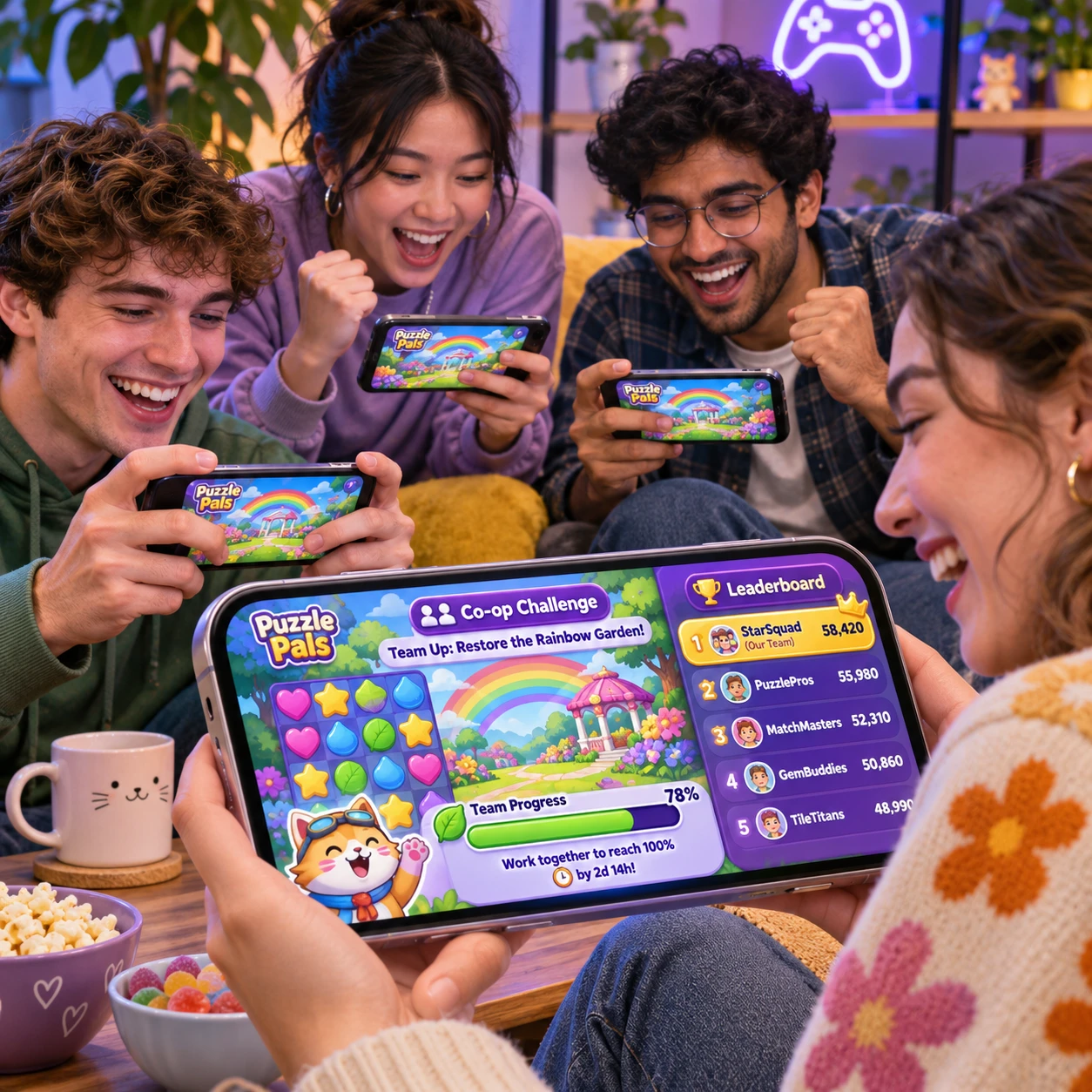
Cooperative play shifts the emphasis from beating another player to working toward a common result. Friends might contribute progress to a team goal, solve a puzzle together, or help one another complete an event. That can suit players who enjoy company but find head-to-head scoring stressful.
These systems work best when the stakes stay proportionate to a casual game. A leaderboard should be a prompt, not a verdict on skill or worth. Players who prefer relaxed sessions may enjoy a challenge more when participation is optional and rewards do not depend on outperforming everyone else.
Playing Together, Even at Different Times
Casual games can feel social without requiring friends to be online at the same time. Asynchronous features let players leave scores, gifts, progress, or challenges for others to respond to later.
For example, one player might finish a level and leave a score for a friend to beat. A teammate may contribute to a shared event in the morning, while another adds progress that evening. Friends lists can show recent activity, and some games let players send a life or a small in-game message without arranging a live session.
This flexibility is useful when people have different schedules, play in short bursts, or use different devices at different times. It also lowers the pressure of coordination: nobody has to pause their day to make a match happen. Asynchronous multiplayer can preserve the feeling of playing alongside someone while keeping each session independent.
There is a trade-off. A score exchange or shared progress bar may feel less immediate than real-time multiplayer, and some players may ignore these features altogether. Games should make the social action easy to understand and avoid making progress depend on a friend’s availability.
Community, Conversation, and Belonging
Player communities and in-game communication can help casual games feel more welcoming by giving players a place to exchange tips, celebrate progress, and share the experience. The right amount of conversation depends on the game and the people playing it.
In-game chat can help friends coordinate a cooperative level or encourage one another during an event. Community spaces may also be useful for practical questions, such as how to approach a tricky puzzle. Even without chat, visible team contributions or shared milestones can create a sense that other people are taking part.
Social spaces need thoughtful boundaries. Public chat may expose players to unwanted messages, while fast-moving communities can make newcomers feel left out. Helpful options include muting chat, blocking users, reporting harmful behavior, and limiting who can contact an account. Clear community rules also make it easier for players to understand what is acceptable.
Belonging should be an invitation, not a requirement. A player should be able to enjoy the core game without joining a group, sharing personal details, or responding to messages. When communities offer useful conversation and sensible controls, they can enrich play without taking over the experience.
How Social Play Can Encourage Players to Return
Social features can give players reasons to return by creating shared goals, changing challenges, or moments they want to experience with friends. They can support ongoing engagement, but they cannot guarantee that a game will remain enjoyable.
A limited-time event might give friends a common target for the week. A cooperative task can make a short session feel purposeful, while a new leaderboard round offers a fresh comparison. Players may also return to see how a friend’s score changed or to continue a team effort.
The strongest motivation tends to come from activities that fit naturally into the game. A small, achievable event can add variety; a demanding schedule of reminders and deadlines can make play feel like an obligation. Designers and players alike should watch for the difference between an appealing reason to return and pressure to check in constantly.
For players, a practical approach is to choose one social activity that sounds enjoyable, such as a weekly challenge or a cooperative goal, and ignore the rest. Social play is most rewarding when it adds a reason to play, rather than replacing the pleasure of the game itself.
Keeping Social Features Enjoyable and Optional
Social features are most enjoyable when players can choose how visible and involved they want to be. Casual games should support different comfort levels, including private play, quiet participation, and direct interaction with friends.
Before joining a feature, check its settings. You may be able to hide your profile from public leaderboards, restrict friend requests, turn off notifications, or mute chat. If a game offers cooperative play, see whether it also provides solo progress or an alternative route to rewards.
Accessibility matters, too. A live event may be difficult for someone with limited time, while chat can be less comfortable for players who prefer not to type or share personal information. Clear instructions, flexible time windows, and non-chat ways to contribute make social activities easier to join.
A useful way to assess any feature is to ask three questions:
- Choice: Can I opt in or out without losing access to the main game?
- Comfort: Can I control who sees my activity and who can contact me?
- Value: Does this interaction make the game more enjoyable for me?
If the answer to the last question is no, there is no need to participate. Friends lists, leaderboards, multiplayer modes, and player communities are options, not obligations. The best fit is the one that makes a casual game more enjoyable on your terms.